


DYNAMIXS.AI is the enterprise AI platform that finally bridges the gap between the systems that hold your data and the intelligence that can act on it — without asking you to compromise on security, governance, or control.
You have seen this movie before. Someone in your leadership team returns from a conference electrified by artificial intelligence. A pilot is launched. Three months later, there is a polished demo, a hopeful presentation, and a quiet admission that the results cannot be replicated in production. The pilot is shelved. The next conference begins. The cycle repeats. If this sounds familiar, you are not alone. A 2025 study by MIT examining 300 public enterprise AI implementations found that 95% of organisations report zero measurable return on their AI investments — and that only 5% of integrated AI pilots ever extract a real profit-and-loss impact. The reason is not that AI is overhyped or that your team lacks ambition. The reason is more fundamental, and once you understand it, the path forward becomes surprisingly clear.
AI doesn’t fail in the lab. It fails because no one ever
— MIT, “THE GEN AI DIVIDE: STATE OF AI IN BUSINESS 2025” · 300 ENTERPRISE
taught it how your business actually works.
IMPLEMENTATIONS STUDIED
The Problem Is Context, Not Capability
The large language models powering today’s AI revolution — OpenAI’s GPT, Google’s Gemini, Anthropic’s Claude — are genuinely remarkable. They possess, as one might say, infinite intelligence and creativity. But they have a fundamental weakness: they lack business context. They do not know your approval hierarchies, your exception handling procedures, your compliance obligations, or the workarounds your team developed three years ago that have since become standard practice.
On the other side of this gap sits your existing infrastructure — the SAPs, Salesforces, and Oracles of the world. These systems hold your data with admirable consistency. They are stable, reliable, and deeply embedded into your operations. But they are also, frankly, rigid. Adapting them to new processes is slow, expensive, and requires specialists who charge ccordingly. They were not built for the speed at which AI wants to move.
WHY MOST AI TOOLS FALL SHORT
Generic AI tools like ChatGPT, Copilot, or standalone LLM wrappers are extraordinarily capable in isolation. They write, summarize, analyze. But they do not know that your finance team handles invoices differently across three subsidiaries. They do not know that procurement requires a dual-approval step above €50,000. They do not know that your logistics partner has a 24-hour SLA that triggers a specific escalation path. Without this context, AI is guessing — and in enterprise environments, guessing is not acceptable.
This is the Enterprise AI Gap: the space between what AI can theoretically do and what it can safely, reliably do inside your real business environment. MIT’s research pinpoints the cause precisely: most AI deployments fail due to brittle workflows and misalignment with daily operations — not because the AI models themselves are inadequate. DYNAMIXS.AI was built specifically to close this gap.
95%
OF ENTERPRISE
AI INVESTMENTS
YIELD ZERO
MEASURABLE
RETURN — MIT,
2025
20+
YEARS OF BPM
TECHNOLOGY AT
THE CORE
2 hrs
TO FIRST
RUNNABLE
PROCESS MODEL
2 wks
TO FULL
PRODUCTION
INTEGRATION
Source: MIT, The Gen AI Divide: State of AI in Business 2025, examining 300 public enterprise AI implementations. Published via AI Magazine, September 2025. aimagazine.com
What DYNAMIXS.AI Actually Does
DYNAMIXS.AI describes itself as “The Trusted Enterprise AI-Process Platform.” That tagline deserves unpacking, because each word carries weight. The platform’s core idea is elegantly simple: before you can trust AI to act inside your business, you must first give it a precise, structured understanding of how your business works. DYNAMIXS.AI calls this the Process Context Engine.
Think of it as a translation layer. On one side, you have your workflows, rules, roles, documents, data, and institutional knowledge — the full complexity of how decisions actually get made in your organization. DYNAMIXS.AI captures all of this using the industry-standard BPMN (Business Process Model and Notation) framework. On the other side, you have AI models capable of reasoning, summarizing, deciding, and acting. The platform injects the business context captured in your process models directly into the AI — so it stops guessing and starts understanding.
For those who want to understand the mechanism without drowning in technical detail: DYNAMIXS.AI does not require you to fine-tune or retrain an AI model — a process that is prohibitively expensive, slow, and risks embedding your sensitive business data permanently into a third-party model. Instead, it uses your BPMN process definitions to build a structured context framework that is assembled dynamically at runtime and provided to the AI alongside each task. The AI receives exactly the process rules, role permissions, data constraints, and decision logic it needs to act correctly in this specific step of this specific workflow — nothing more, nothing less. Security and IT teams will recognize this pattern: it is overned, auditable, and keeps your proprietary process logic firmly under your control.
The result is what the company calls Context-Aware AI Process Automation: AI that knows the rules, understands the exceptions, respects the approvals, and produces outputs that are not just plausible, but auditable and compliant.
Process-Centric AI — Not AI Bolted Onto a Process Tool
This distinction matters enormously. Many platforms that have added AI features in recent years have done so as an fterthought — a chatbot here, a summarization feature there. DYNAMIXS.AI was designed from the ground up around the principle that AI must be embedded within process logic, not layered on top of it. BPMN-based workflows provide full uditability and control. Every AI action is governed, traceable, and explainable. For regulated industries — finance, logistics, healthcare, government — this is not a nice-to- have. It is a prerequisite.
Addressing the Fear Factor
Let us be direct about something. If you are reading this as a BPM professional in a large or mid-sized enterprise, there is a good chance that AI provokes as much anxiety as excitement in your organization. The concerns are legitimate: What happens to our data? Who controls the AI’s decisions? What if it makes a costly mistake? How do we explain a machine’s reasoning to an auditor? DYNAMIXS.AI was built with these concerns as design constraints, not afterthoughts. Here is what that means in practice.
Data Sovereignty — Your Data Stays Yours
One of the most common — and most reasonable — objections to enterprise AI is the question of data privacy. When you send a document to a commercial LLM service, where does that data go? Who trains on it? What are the GDPR implications? DYNAMIXS.AI provides a clear answer: the platform is fully GDPR-compliant, ISO-certified, and — critically — no external AI provider accesses your data. The architecture supports both SaaS and on-premise deployment, giving regulated organizations the option to keep everything behind their own firewall. Data is encrypted, auditable, and always under your control.
Open LLM Integration — No Vendor Lock-In
Rather than tying customers to a single AI provider, DYNAMIXS.AI supports flexible LLM integration. This means your organization can choose which models to use — whether that is an open-source model running on your own infrastructure, a European AI provider, or one of the established commercial APIs — and switch as the landscape evolves. This architectural openness is a significant advantage for organizations that are rightly cautious about committing to a single AI vendor’s roadmap.
Identity & Access Management — AI Within Your Governance Structure
Every enterprise has a carefully constructed hierarchy of permissions and roles. DYNAMIXS.AI integrates full Identity and Access Management (IAM) natively into its platform. This means AI agents operate within the same governance boundaries as human users — they can only see, access, and act on what the process model and your security rules permit. There are no hidden backdoors, no shadow processes.
How It Compares: The Market Landscape
DYNAMIXS.AI positions itself in a market that includes both legacy BPM platforms and newer AI automation tools. Understanding where it sits — and why it occupies a distinct position — requires an honest look at the alternatives.
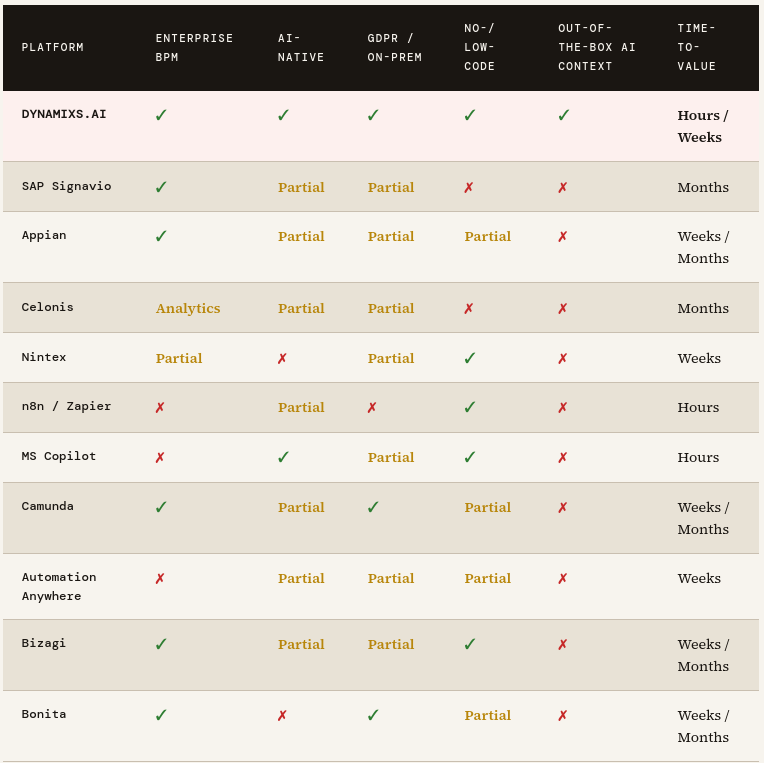
The matrix above is not a ranking of quality — it is a map of trade-offs. The established platforms in this list are mature, capable products with large customer bases and deep ecosystems. The honest question is not whether they can do these things, but at what cost and complexity. A seasoned Camunda architect will rightly point out that Camunda 8 can be connected to AI services via its Connector framework. That is technically true — and it also requires a dedicated engineering team, custom integration work, and months of implementation time. The same logic applies to SAP Signavio, Appian, Bizagi, and Bonita: the capability exists in principle, but it lives behind a wall of developer effort, consultant budgets, and project timelines that most business and process owners cannot independently control.The matrix above is not a ranking of quality — it is a map of trade-offs. The established platforms in this list are mature, capable products with large customer bases and deep ecosystems. The honest question is not whether they can do these things, but at what cost and complexity. A seasoned Camunda architect will rightly point out that Camunda 8 can be connected to AI services via its Connector framework. That is technically true — and it also requires a dedicated engineering team, custom integration work, and months of implementation time. The same logic applies to SAP Signavio, Appian, Bizagi, and Bonita: the capability exists in principle, but it lives behind a wall of developer effort, consultant budgets, and project timelines that most business and process owners cannot independently control.
Automation Anywhere occupies a different category altogether. It excels at robotic task automation — scripting repetitive, screen-level interactions with precision. But RPA and enterprise process orchestration solve fundamentally different problems. Automating a step is not the same as governing a workflow with its full complexity of exceptions, approvals, escalations, and real-time decisions. n8n and Zapier, meanwhile, are powerful integration pipelines — ideal for developers connecting APIs, but without the process governance layer that enterprise environments require. Microsoft Copilot brings AI directly into productivity tools, but operates without awareness of your structured process logic, making it unsuitable as a standalone governance layer for mission-critical workflows.
This is the column that matters most for your organization: Out-of-the-Box AI Context. Not “can it be built?” — with sufficient budget and time, almost anything can be built. But “does it work, governed and auditable, from day one, for a process owner who is not a software engineer?” That is the question DYNAMIXS.AI was designed to answer with a clear yes.
A Real-World Demonstration: Global Logistics
Abstract architecture diagrams are reassuring, but nothing makes a platform’s value proposition clearer than a concrete implementation story. Here is one DYNAMIXS.AI has documented from the global logistics sector.
A logistics company facing a rapidly growing invoice volume — increasing by over 500 invoices per day — found itself overwhelmed by the complexity of its financial workflows. Its ERP system could not communicate directly with its payment system. Finance and payment management had grown highly complex. Most critically, there was no consistent transparency across financial processes, making cash flow planning unreliable.
DYNAMIXS.AI implemented a tailor-made, AI-supported accounts receivable and payable process. A flexible API connected the ERP system to the payment infrastructure. Real-time monitoring was established across all relevant financial workflows. The outcome: a 30% faster process cycle time, reduced manual effort in the finance system, and — in the words of the customer — “full transparency over every process and our cash flow under control at all times.“
“With the solution of DYNAMIXS.AI, we have now full transparency over every process and our cash flow under control at all times.”
— CUSTOMER, GLOBAL LOGISTICS SECTOR
This is the pattern DYNAMIXS.AI replicates across industries: a clear business problem, an intelligent process model built on the platform, integration with existing enterprise systems via standard APIs, and measurable operational improvement — typically delivered within two weeks.
The Team Behind the Platform
Enterprise software lives or dies by the credibility of the people who build it. And sometimes the most important thing to understand about a product is not what it does, but why its founders decided to build it in the first place.
Hans-Peter Fischer, Ralph Soika, and Gaby Heinle did not come to AI from the outside. They spent over two decades inside enterprise BPM — implementing it, consulting on it, watching it succeed, and watching it fail. What they kept encountering, project after project, was the same frustrating pattern: well- designed processes that collapsed in production because the software was too rigid, too slow to adapt, and too disconnected from the intelligence that could make it work. When modern AI arrived with its extraordinary capabilities, they saw immediately both the opportunity and the danger — that AI would be adopted enthusiastically, fail quietly, and leave organizations more cynical than before. They built DYNAMIXS.AI because they were tired of watching BPM projects fail due to rigid software, and tired of watching AI pilots die because nobody had built the bridge to operational reality.
CEO Hans-Peter Fischer brings product management, business development, and startup experience including a tenure at the BMW Startup Garage. CTO Ralph Soika contributes two decades of software development, BPMN expertise, ITIL operations knowledge, and AI/LLM engineering. COO Gaby Heinle bridges the gap between customer processes and AI implementation with her background in BPMN consulting and software development. The platform reflects over 600,000 lines of production code — not a prototype assembled for a demo, but infrastructure that has already proven itself in logistics, finance, HR, and government environments.
Getting Started: Four Steps to a Trusted AI
Platform
For BPM professionals who have spent years navigating the gap between business requirements and technical implementation, DYNAMIXS.AI’s approach to onboarding will feel both familiar and refreshingly efficient.
Step one is capturing your business reality. Your processes, data, and expert rules are modeled exactly as they exist — not as an idealized future state, but as the complex, exception-laden, workaround-rich reality of your actual operations. This is where DYNAMIXS.AI’s BPMN foundation earns its keep.
Step two is building the workflow model — and here the platform’s speed becomes apparent. A first running version of your system can be created within hours. Not days. Not weeks. Hours. This is possible because DYNAMIXS.AI’s template library provides proven building blocks for finance, HR, procurement, and logistics that can be immediately adapted to your specific context.
Step three is customization with templates. Ready-to-use components dramatically reduce development work. And because the platform is no/low-code by design, your process experts — not just your developers — can participate in building and refining the models.
Step four is deployment, learning, and continuous improvement. Once live, the system collects process data, surfaces bottlenecks, and enables the kind of continuous optimization that manual process management simply cannot sustain.
“A productive solution in just 2 weeks — and our process adjustments were done within hours.”
— CUSTOMER, HUMAN RESOURCES
The Honest Case for Acting Now
There is a temptation, especially for large organizations, to wait. To watch the AI market mature. To let others absorb the risk of early adoption. This is a rational instinct, and in many technology cycles it has served conservative enterprises well.
This cycle is different in one important respect: the competitive advantages being built by organizations that successfully deploy AI inside their processes are compounding. Every process that becomes faster, more accurate, and more transparent creates data that makes the next process improvement easier. Organizations that are two years ahead of you in this journey are not just operationally faster — they are building institutional intelligence that will be very difficult to replicate under time pressure.
The good news is that DYNAMIXS.AI removes the primary risk of early adoption: the fear that a complex, expensive AI implementation will fail in production, consume enormous internal resources, and leave you worse off than when you started. With a two-week deployment path, full data sovereignty, open LLM integration, and a genuine enterprise governance foundation, the risk profile looks quite different from the AI horror stories you have heard.
You do not need to replace your ERP. You do not need to rebuild your IT infrastructure. You do not need to hire a team of AI specialists. You need a platform that bridges the gap between the intelligence of modern AI and the operational complexity of your real business — safely, quickly, and with full control.
That is what DYNAMIXS.AI is built to do.